Read More
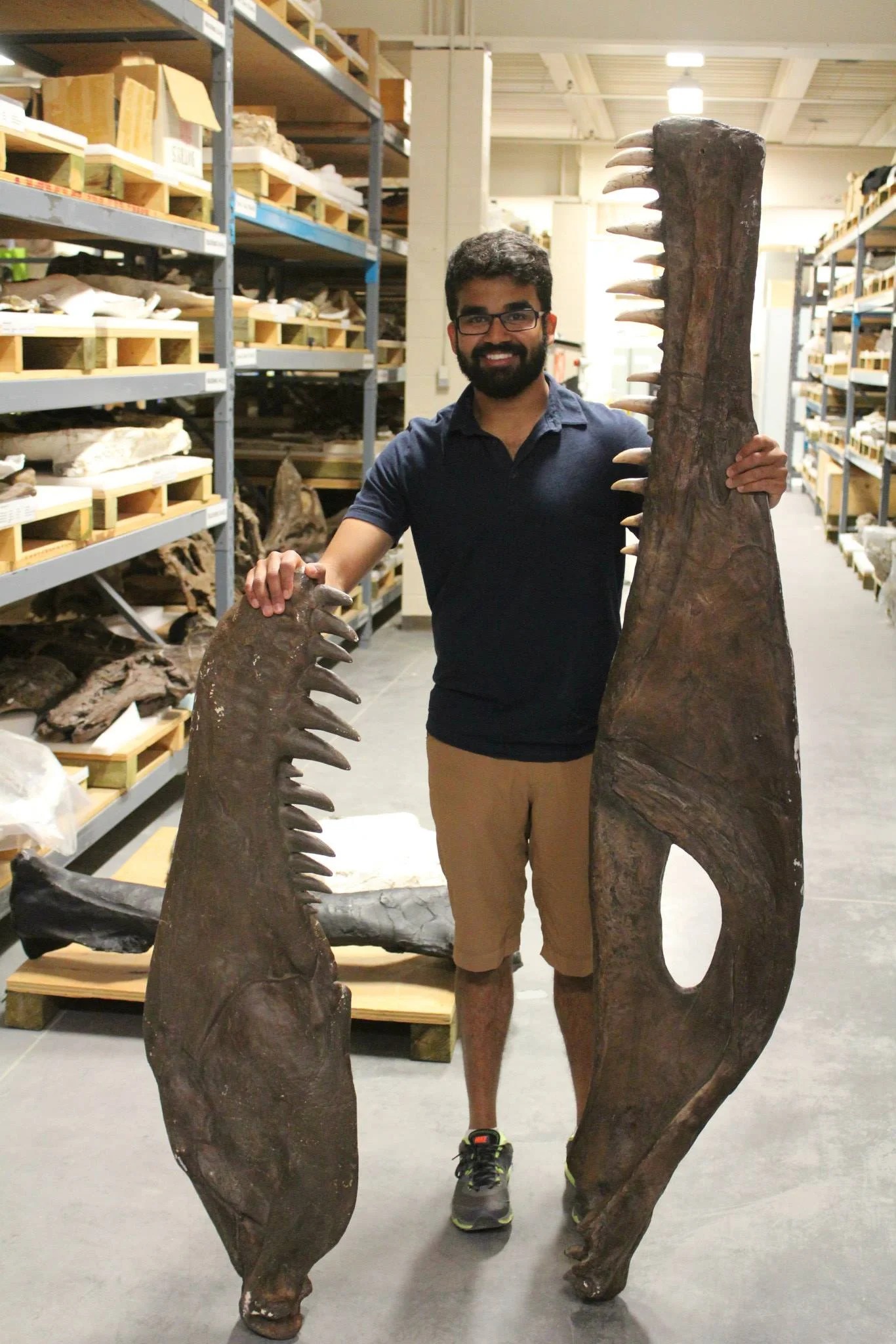
I then had the good fortune of being able to build my research experience by working at and with various museums – the Royal Tyrrell Museum of Paleontology & Royal Ontario Museum. This work really catapulted me into paleontological research, which in my case concentrates on the bio-mechanics (movement) of extinct animals. Recently I’ve begun working as a paleontological resource consultant. As a resource consultant I travel around Alberta assessing the environmental impact of development on fossil resources. This work falls under Alberta’s Historical Resources Act (1979), which deemed fossils an important cultural resource in need of protection and conservation. I’ve had good luck to have fallen into this career because of my experience conducting fossil excavations in the Badlands and Rocky Mountains of Alberta.
What is your educational background?
I earned an Honours Bachelors of Sciences from the University of Toronto, Mississauga Campus. Concentrating in Biology, Paleontology, and Geology. I recently completed a Masters of Science at the University of Calgary, concentrating on Paleontology, in Ecology and Evolutionary Biology.
What are your daily responsibilities?
My primary duties right now include digitizing fossils into 3D models. I use a method called 3D photogrammetry to take photos of fossils from hundreds of angles and then process them into 3D virtual computer models. This allows us to look at there morphology (shapes, sizes), and learn about there biomechanics. I also render 3D models of fossils using CT scanners – a CT scanner is a type of radio-graph machine that creates serial X-ray images of (in this case) fossils. We can take those X-ray images and render them into 3D models on a computer, to be used for research. Finally, I do fossil preparation, which is a process of removing rock and sediment off of fossils so that they can be more closely looked at for research or display purposes. This work can involve long hours looking through a microscope at tiny fossils…or it can involve large abrasive tools like hammers, awls, or even jackhammers (on a handful of occasions). When I’m out on a consultation project I’m generally at a remote field location or construction/ land development site. I use a number of geological techniques (stratigraphic measurements, mapping, sediment identification) to assess if fossils are present. I either collect the specimens, or document their presence. After which I write a report about my findings, create maps of their localities, and present them to the client.
What hurdles did you face?
Paleontology is dominated by white males. As a person of colour I’ve often found myself working as the only minority (or one of a very few) in my field. This is starting to change, as more and more minorities and women are beginning to take up paleontology – which is a great thing. However, I have found myself in remote places and conferences where I felt like I had to represent myself a little more professionally, because I already stood out from the crowd.
What advice would you give to the 15-18 year old version of yourself?
I grew up knowing that becoming a paleontologist was not a normal career path. There were many people (family and friends)who questioned why I chose pursue this field. But the one thing that I never stopped doing, was believing in myself. If you have a goal, if you have a dream, you will achieve it. It will take hard work, and at times it will seem like you’ll never get there. But always remember that even if you’re dream seems impossible, outlandish, or not normal to others – as long as you believe in it, then you will succeed.
Proceed as if success is inevitable.
Salary Range
Education
Demand
Meet a Professional
Core Responsibilities
Typical Workplace
Attributes & Abilities
High School Course Requirements (Ontario)
Grade 12
English (ENG4U)
Mathematics (MHF4U & MCV4U)
Chemistry (SCH4U)
Biology (SBI4U)
Physics (SPH4U)
*Additional 4U/M Courses For University Candidates*